Invoicing software development, built into your ERP Invoices that follow the rules, every time
ANTASY IT (a.it) builds invoicing modules into custom ERPs and business applications: numbering, credit notes, VAT per rate, stamp duty, withholding tax and printable invoices, designed around your documents and what your accountant needs. The TSS Company ERP and our own product, Facturty, run on this work.
- Documents
- Quotes · Delivery notes · Invoices · Credit notes
- Tax rules
- VAT per rate · Stamp duty · Withholding tax
- Running at
- TSS Company · Facturty (our product, demo)
- Last reviewed
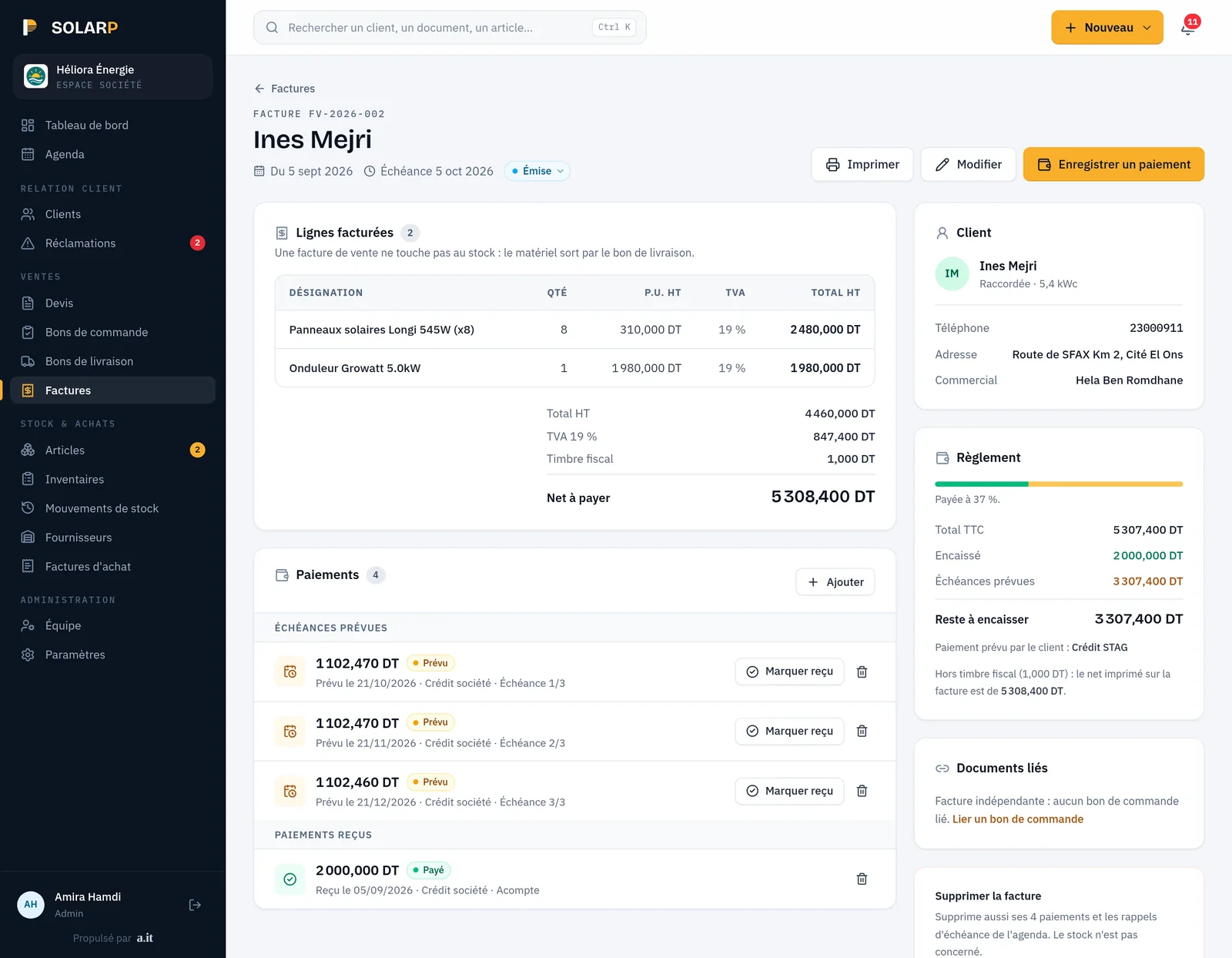
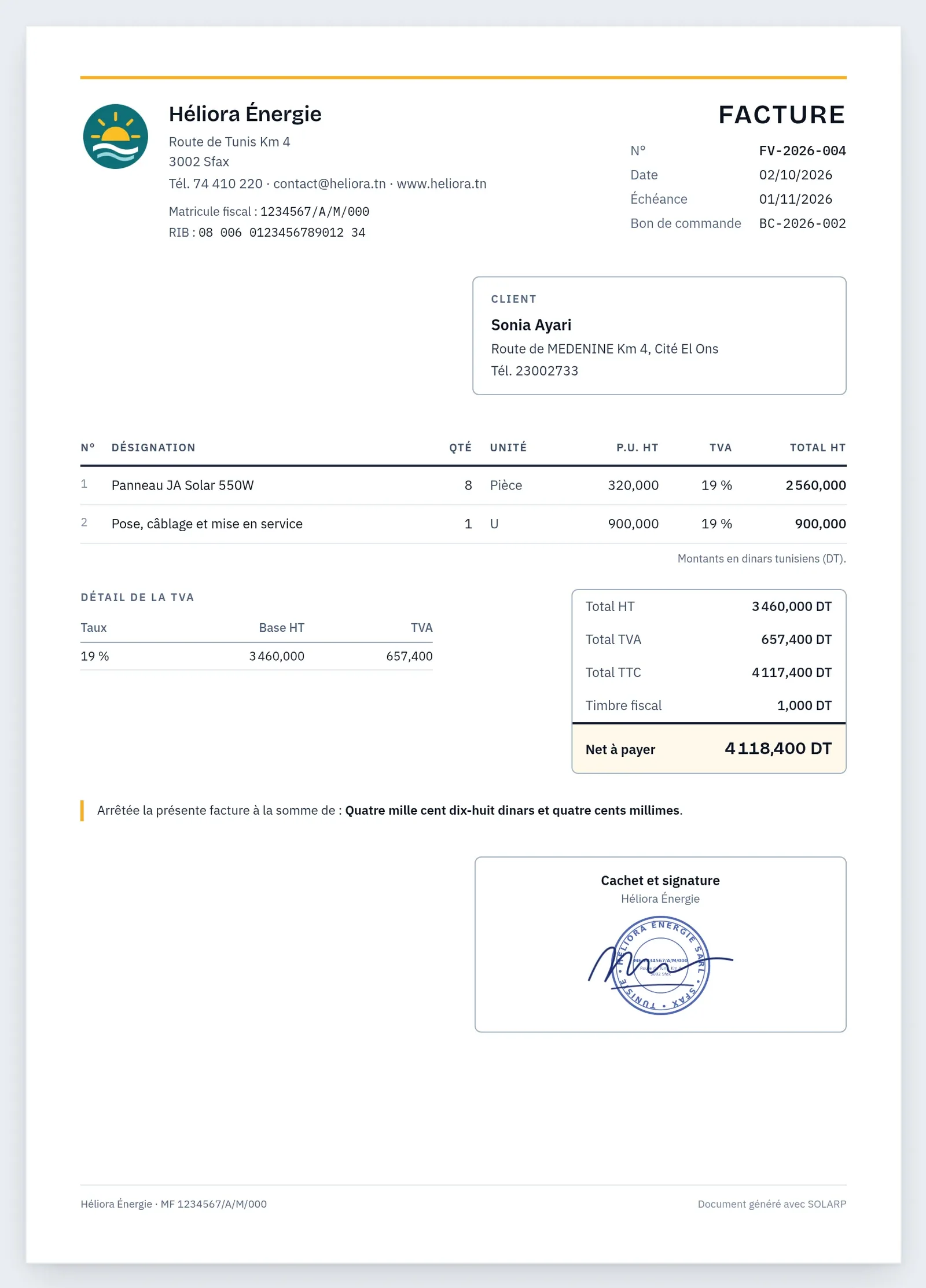
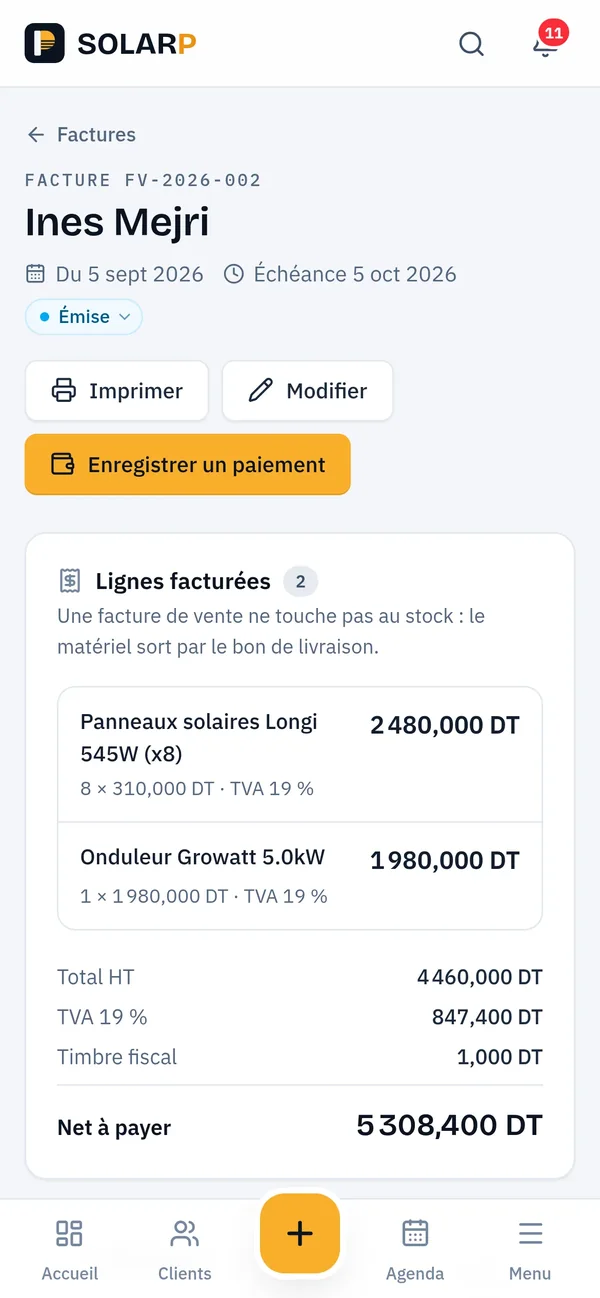
An invoice with VAT and stamp duty, on demo data.
Overview
What does a custom invoicing module do?
An invoicing module turns validated deliveries and services into numbered, complete invoices, then follows each one until it is paid or corrected by a credit note. ANTASY IT builds it inside your ERP or business application, so invoices share customers, items, stock and payments with the rest of the system instead of living in a separate tool.
01
Quote
sent, accepted or refused
02
Delivery note
created from the quote
03
Invoice
created from the delivery note
04
Payment or credit note
settles or corrects it
Built-in matters more than it sounds. When the invoice is created from the delivery note, quantities and prices cannot drift between the two. When a payment is recorded against the invoice, the amount still due is always current. When a credit note cancels part of an invoice, the customer balance follows: invoices, minus payments, minus credit notes, minus justified withholding tax.
Many companies already have an invoicing tool. What they lack is the link between that tool and everything around it: quotes in one place, deliveries in another, payments in a notebook. The module is built to close those gaps first.
Rules built in
Which rules does the software enforce?
These are the rules we have coded and run in production. Your own rules are added in the same way during discovery.
- Numbering
- An independent sequence per document type, restarted each year: a prefix, the year and a six-digit number. The goal is no gap and no duplicate.
- Credit notes
- A validated invoice is corrected by a credit note, total or partial, with a reason: a return, an error, a commercial gesture or a failure under warranty.
- VAT per rate
- Each line carries its VAT rate; the invoice shows the totals per rate, excluding and including VAT. A VAT-exempt invoice requires a valid exemption certificate on file.
- Stamp duty
- Added to each invoice where the law requires it, skipped for exempt customers such as public bodies. The amount is a setting, not hard-coded.
- Withholding tax
- Estimated from the customer’s rate, then confirmed by the certificate the customer sends. Missing certificates are flagged for follow-up.
- Three decimals
- Amounts are computed and rounded to the millime, the thousandth of a Tunisian dinar. Two-decimal rounding makes totals differ from the millime amounts on your invoices.
- Totals on the server
- The API recomputes every total from the lines. A figure sent by a browser is never trusted as such.
Supplier invoices
Can supplier invoices be read automatically?
Yes. In Facturty, a scanned or photographed supplier invoice is read by a vision model, Mistral’s Pixtral, which returns the supplier, the buyer, their tax IDs, the number, the date, every line with its VAT rate, the totals and the stamp duty. ANTASY IT shows the result in an editable form; nothing is saved before a person checks it.
Two details made the difference in practice. Some Tunisian invoice layouts label the buyer’s block “Supplier”, so the model is told to identify the seller from the issuer block, never from labels alone. And amounts written as 480,000 mean 480 dinars to three decimals, not 480 thousand. Both rules are written into the extraction instructions.
The same approach can feed any purchase module, as described in system integration.
E-invoicing
Is it ready for e-invoicing?
Ready in its data, not yet connected. ANTASY IT has not delivered a connection to an e-invoicing platform in production so far. What we do today is build invoices with the data e-invoicing requires: tax IDs of both parties, structured lines, VAT per rate and unbroken numbering, so the connection can be added when your obligations require it.
E-invoicing rules differ by country. In Tunisia, electronic invoices go through the El Fatoora platform run by Tunisie TradeNet (TTN). In the European Union, national systems build on the European standard EN 16931. In both cases the hard part is not the file format; it is having clean, complete invoice data in the first place.
For Tunisia, one step is already written. In the development version of Facturty, our own invoicing software, invoices are converted to TEIF, the XML format TTN publishes for El Fatoora (schema version 1.8.8), and the output is checked by automated tests. The electronic signature and the transmission to the platform are not built yet: they require the company’s own registration with El Fatoora and a qualified electronic certificate in its name.
When you need the connection, we scope it from the official technical documentation of the platform concerned and test it before any real invoice is sent. We will not describe it as done before it is.
Running in production
Where does this invoicing run?
In the TSS Company ERP, where the team issues its quotes, delivery notes, invoices and credit notes every day, and in Facturty, our own invoicing and stock software, shown today as a demo ahead of its public launch.

TSS Company
Quotes, delivery notes, invoices, credit notes and payments, with VAT per rate, stamp duty, estimated withholding tax, exemption certificates and yearly numbering per document type.
Facturty
Quotes, delivery notes, sales and purchase invoices, credit notes and stock movements for Tunisian SMEs, with AI reading of supplier invoices. Angular, PrimeNG and Strapi 5.
- Custom ERP
Stock, purchasing and workshop around the invoices.
- Custom CRM
Payments, instalment plans and what is still to collect.
- How we price projects
Fixed scope or milestones, and what drives the cost.
FAQ
Invoicing questions
Can you add invoicing to an application we already use?
Often, yes. If your application has an API or a database we can work with, the invoicing module can read its customers and deliveries and write invoices back. We look at the existing system first and tell you whether adding a module or replacing the tool is the cheaper option over time.
How do you correct an invoice that is already validated?
With a credit note rather than an edit. The credit note is total or partial, records its reason (a return, an error, a commercial gesture or a failure under warranty) and reduces what the customer owes. The original invoice stays as issued, and the module can lock validated documents so nobody edits them by mistake.
What does our accountant get from the system?
We ask your accountant during discovery. Invoices, credit notes, payments and VAT totals per rate are all stored as structured data, so they can be listed per period or exported in the layout the accountant works with. We do not replace their software; we feed it cleanly.
Is AI reading of supplier invoices reliable enough?
It removes most of the typing, not the checking. In Facturty, the model’s output fills an editable form and the totals are recomputed from the lines, so a misread figure shows up as a difference. A person confirms every purchase invoice before it is saved and before stock moves.
Do you handle withholding tax certificates?
Yes. In the TSS Company ERP, withholding tax is estimated on each invoice from the customer’s rate, and each payment records whether a certificate is not applicable, expected or received. Filtering payments on “expected” lists the certificates still to chase, which is what usually goes missing at year end.
Can you connect our invoices to an e-invoicing platform?
We prepare for it but have not delivered such a connection yet, and we say so plainly. Our invoices already hold the data these platforms require. When your obligation starts, we scope the connection from the platform’s official specifications and test it with you before the first real invoice is sent.
Invoices still typed by hand? Show us one
Send a sample invoice and a delivery note. We will tell you which rules the module would enforce.